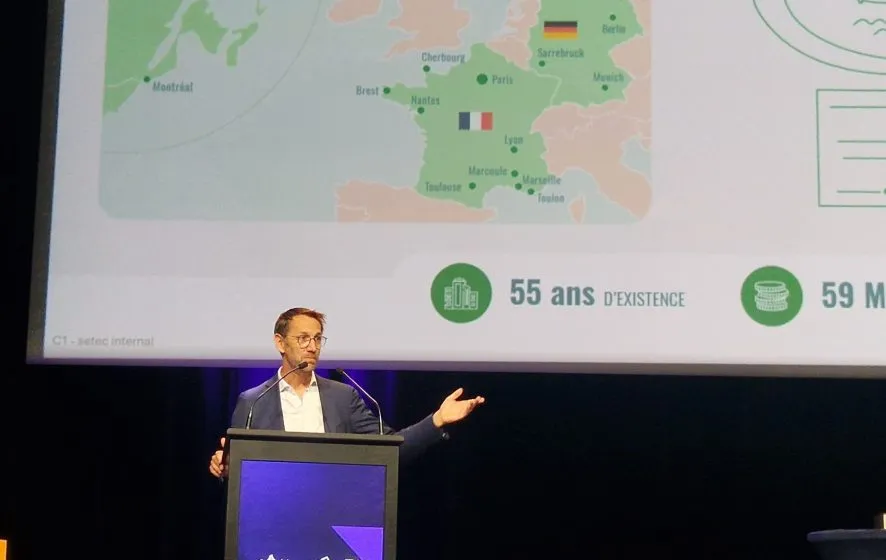


The central challenge in change is not strategy or systems, but behavior.
John Kotter
The Need to Evolve Has Become Critical
We live in a world where certainties are melting faster than strategic plans. Across all industries – transport, energy, aerospace, defense, IT – organizations are facing an accelerating combination of market volatility and technological complexity. In this context, agility is no longer a methodological option, but a structural response to instability.
The State of Agile Report 2025 marks a clear shift: agility is no longer assessed based on the deployment of frameworks, but on its ability to generate measurable value for both the business and its customers. At the same time, Artificial Intelligence is becoming deeply embedded in value chains and delivery cycles, accelerating flow, enhancing decision-making, and exposing existing organizational dysfunctions.
In this evolving landscape, agile transformation can no longer be approached as a program to roll out. It must be understood as a systemic and cultural shift, grounded in continuous learning, adaptation, and the ability to sustainably evolve collective behaviors.
As John Kotter emphasizes, many transformations fail, not primarily due to a lack of methodology, but because of insufficient meaning, engagement, leadership, and shared culture. Organizations that succeed understand that transformation is not a temporary effort, but a continuous, demanding, and deeply human journey.
Why Organizations Struggle to Adapt
The reality is clear: traditional organizational structures designed for a world where stability was the norm are no longer fit for purpose. They are increasingly overwhelmed by constant technological acceleration, which reshapes the rules of the game on a daily basis.
Today, time-to-market pressure leaves no room for slow decision cycles, while global competition demands continuous responsiveness. At the same time, organizations face intense pressure in the war for talent, competing to attract increasingly demanding profiles while trying to retain customers accustomed to abundant and immediate offerings.
In this context, many organizations launch agile transformations by imitation without a clear vision or adequate support only to face strong resistance and eventual rejection.
→ Successful transformation is fundamentally about evolving mindsets and collective behaviors; tools, processes, and frameworks are merely enablers of that change.
The Root Causes of Failure
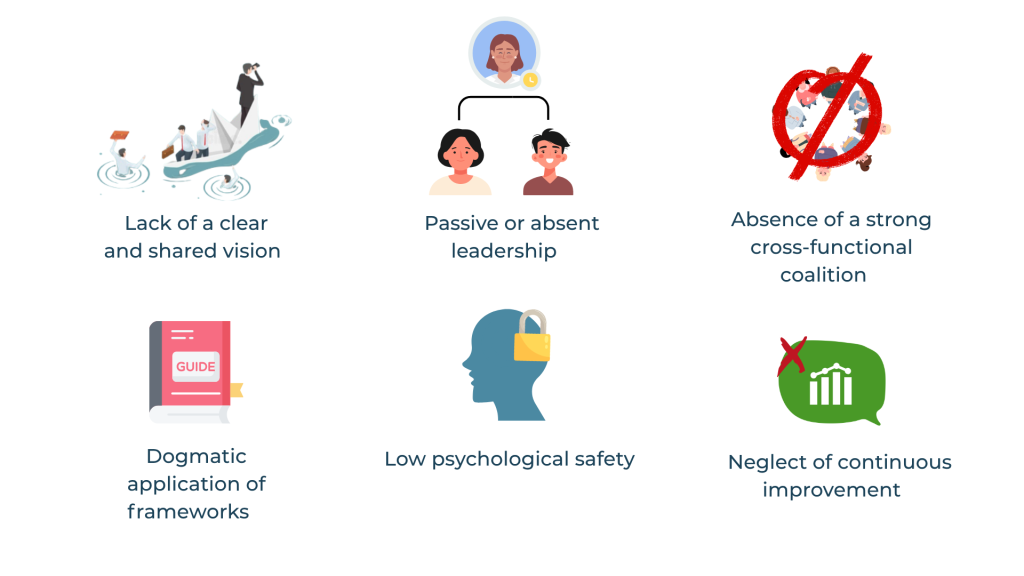
Experience and research converge on a consistent conclusion: the roots of failure lie in leadership and culture. Organizations do not become agile by changing rituals or tools, but by transforming how people work together.
Common anti-patterns include:
Driving Transformation Through Value: The True Compass
You don’t transform an organization by monitoring team activity like a supervisor. The real issue lies in prioritizing reporting over actual value. Moving away from this requires a deep anchoring in Lean thinking, far beyond superficial or vanity metrics.
A successful transformation is based on a simple principle: the goal is not to produce more, but to produce better, faster, and with greater purpose.
This means reducing waste, improving flow, identifying and eliminating bottlenecks, and continuously evolving the system.
While not exhaustive, the following flow-based indicatorsare particularly relevant:
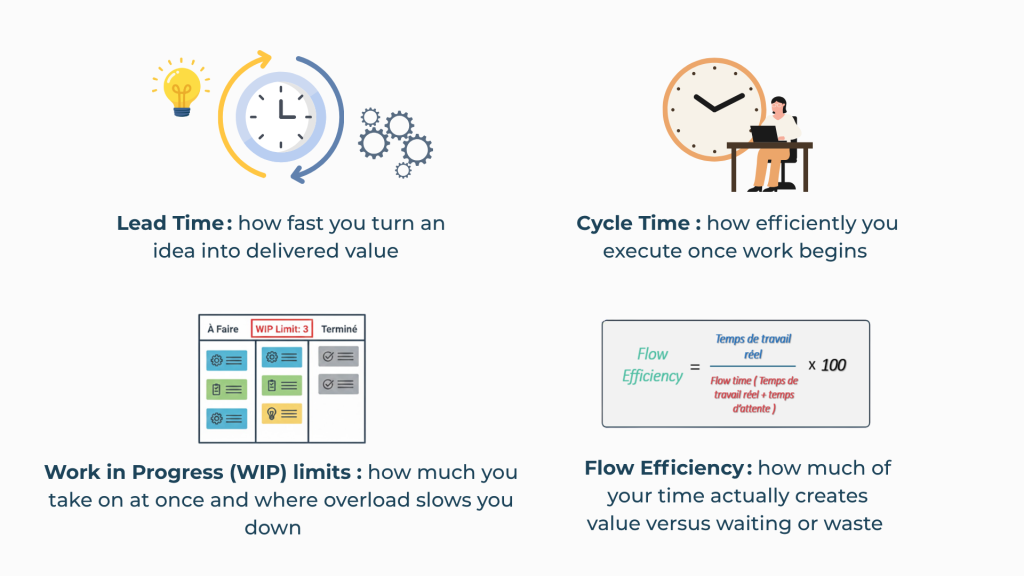
→ These metrics enable objective, fact-based steering of progress, replacing bureaucratic reporting with real operational feedback.
Leadership and Change Coalition
Every sustainable transformation starts at the top. Leadership is not about supporting change, it is about embodying it.
Leaders must lead by example through transparency, humility, active listening, and the ability to treat failure as a source of learning. They must foster collaborative decision-making, ensure the right conditions for success, and build a strong coalitioncapable of driving change across the organization.
As Kotter emphasizes, no deep transformation succeeds without a powerful, cross-functional coalition.
Evolving Without Destroying What Already Exists
“You never change things by fighting the existing reality. To change something, build a new model that makes the existing model obsolete.” – Buckminster Fuller
Transformation is not about destruction. It is not about erasing the past or abruptly replacing existing systems. One effective approach is the concept of a Dual Operating System proposed by the SAFe framework: a traditional system ensuring stability and execution, coexisting with a dynamic, value-driven system focused on innovation and exploration. The latter gradually becomes the engine of transformation.
→ The objective is not to tear everything down, but to progressively build a more effective model that wins through its ability to deliver greater value.
Test, Learn, Adapt: Tailoring Agility
Frameworks provide structure, but agility is not a standard, and there is no universal model.
The right approach is the one you build through experimentation, iteration, and continuous adjustment. As Deming highlighted, performance emerges from the cycle: Plan — Do — Check — Act (or Adjust or Adapt).
Agile transformation must remain empirical and alive. While designing a tailored approach is essential, continuous improvement must not be neglected; it is often the first casualty under pressure. Retrospectives are too frequently sacrificed, even though they are the team’s engine for learning.
Challenging assumptions is as critical as regularly reassessing the vision, to avoid gradual obsolescence.
Psychological Safety: A Prerequisite for Innovation and Continuous Improvement
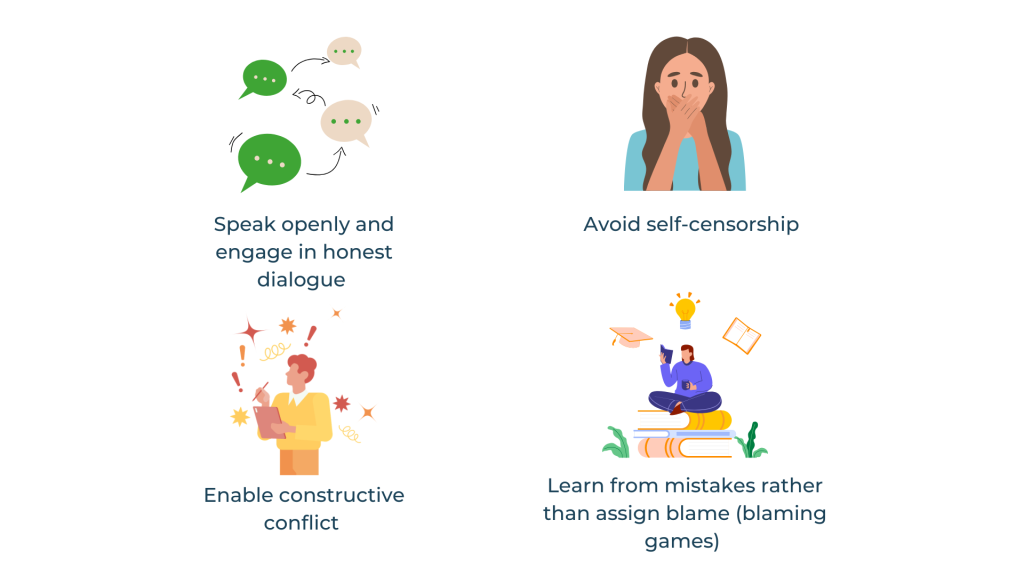
As Amy Edmondson has demonstrated, innovation is impossible without psychological safety. This topic alone deserves a dedicated article, but at its core, it is about creating an environment where individuals feel safe to contribute, challenge ideas, experiment, and learn.
It means building a foundation where people can:
A team that is afraid takes no risks. And an organization that stops taking risks slowly declines.
Psychological safety is therefore an essential condition for decentralized decision-making to function effectively and for continuous improvementto truly take root.
… to be continued in Part 2.
For further