
Continuation of Part 1.
Driving Sustainable Transformation Through Key Roles
A successful transformation is enabled by a core set of experienced roles and change agents capable of orchestrating human, organizational, and systemic dimensions in a coherent way.
Continuous learning, transformation coaching and the activation of communities of practice combined with strong, experience-based delivery support, act as powerful levers to foster co-creation, accelerate adoption and build internal capabilities. Over time, these foundations enable the organization to progressively gain autonomy and sustain its transformation. 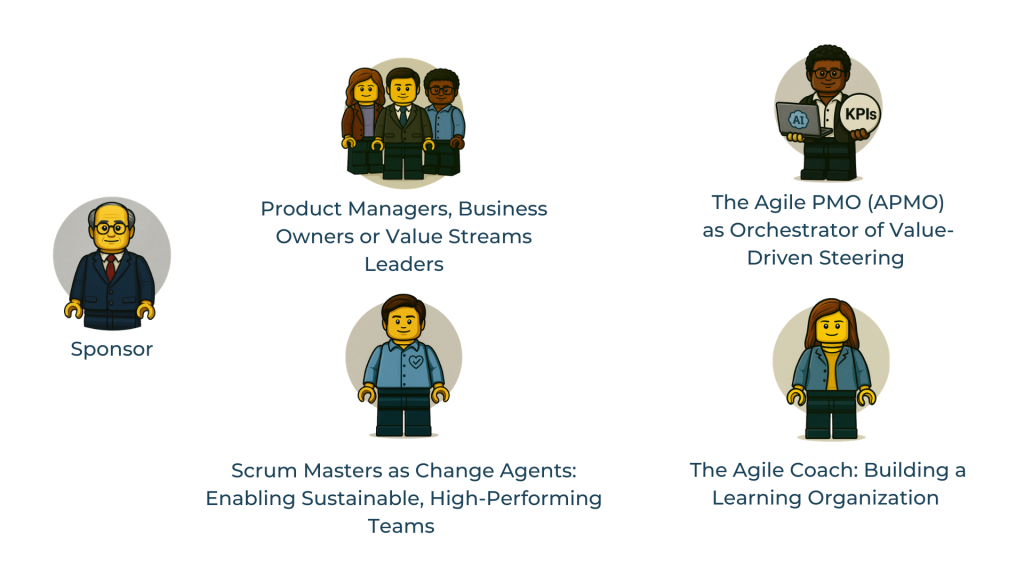
However, such support cannot be effective without clearly committed leadership. Any sustainable transformation requires a designated sponsor who can arbitrate priorities, protect teams, remove structural barriers and lead change from the top. This role cannot be delegated—it is fundamental to the credibility and long-term continuity of the transformation.
Moreover, a value-driven approach to management requires clear accountability, embodied by product and value stream-oriented roles.
Product Managers, Business Owners or Value Streams Leaders
These roles are critical in linking strategic intent with day-to-day decision-making. They ensure alignment between priorities and execution, preventing local optimization and consistently focusing efforts on delivering meaningful business outcomes and customer value.
In this context, three complementary roles, working in close collaboration, make the transformation tangible, measurable and sustainable.
The Agile PMO (APMO) as Orchestrator of Value-Driven Steering
Far from the traditional image of a control and reporting function, the Agile PMO acts as the guardian of systemic coherence. It enables a seamless transition from strategy to execution by making value flows visible and understandable.
By shedding light on how the system truly operates, it ensures that decisions are no longer driven by opinion, but by data—prioritizing customer and business impact over activity for its own sake.
Increasingly, this role is supported by tools enhanced with Artificial Intelligence. In this context, AI acts as a powerful amplifier of steering capabilities: it can analyze large volumes of data, identify bottlenecks, anticipate risks, and simulate prioritization scenarios. Rather than automating decisions, it enhances their quality, speed and reliability.
To fulfill this mission, the APMO leverages a set of key practices and tools, including:
- Value Stream Mapping, enriched with data-driven flow analysis
- Lean Portfolio Management and value‑based prioritization
- OKRs (Objectives & Key Results), linking strategic intent to operational outcomes with dynamic impact tracking
- Visual management and risk management, including proactive detection of weak signals
Scrum Masters as Change Agents: Enabling Sustainable, High-Performing Teams
An experienced Scrum Master understands that their stance must remain adaptive, and context driven. Rather than rigidly applying a framework, their role is to support the team’s growth toward autonomy and sustainable high performance. They foster effective collaboration, enable continuous improvement and actively cultivate psychological safety as a foundation for long-term success.
Artificial Intelligence should serve as an enabler for the Scrum Master—not a replacement. When used effectively, it can enhance the analysis of team rituals and workflow data, helping to surface insights and improvement opportunities. However, it has clear limits where human interaction begins. Listening, stakeholder engagement, situational awareness and the development of trust remain inherently human capabilities that are essential to building strong, resilient teams.
Beyond mindset and posture, the Scrum Master also leverages a set of practical tools and practices to accelerate change, including:
- Advanced facilitation techniques (e.g., Liberating Structures), supported by AI-assisted preparation and synthesis
- Team Topologies to design effective team interactions and dependencies
- Team diagnostics (e.g., Team Health Checks), combining qualitative and quantitative insights to monitor morale and performance
- Facilitation and continuous improvement of agile ceremonies, including identification and resolution of anti-patterns through targeted problem-solving workshops
- Conflict resolution and the facilitation of psychological safety, as prerequisites for any sustainable improvement
The Agile Coach: Building a Learning Organization
The Agile Coach operates at a deeper, systemic level. Their mission is to develop the organization’s internal capabilities, evolve leadership mindsets and embed a lasting culture of learning and continuous improvement. Acting as a catalyst, they enable both cultural and systemic change across the organization.
At this level, AI can become a powerful lever for organizational learning. It facilitates the capitalization of feedback, the identification of recurring cultural patterns and the development of personalized learning paths.
Once again, AI accelerates learning without ever replacing the work on behaviours, trust, and purpose.
To fulfill this role, Agile Coaches typically rely on a range of practices and tools, including:
- Individual and collective coaching, supported by feedback and data-driven insights.
- Evolution of leadership behaviors toward leading by example.
- Development of soft skills (active listening, emotional intelligence, conflict resolution).
- Coaching continuous improvement cycles (e.g., PDCA) and fostering a Kaizen culture, with structured learning capture
- Use of an “improvement-focused” Kanban systems to make organizational impediments visible and actionable
These roles, practices, and tools, including those enhanced by Artificial Intelligence, are not ends in themselves. Their true value lies in serving a broader ambition: strengthening the organization’s collective ability to learn, adapt and continuously deliver meaningful and sustainable value.
Key Takeaways: Agility as a Sustainable Strategic Capability
Agility is neither a methodology nor a project with an end date. It is a collective strategic capability, built over time by the people who make up the organization.
A successful transformation is not a collection of checklists, but the alignment of three fundamental pillars:
- The Directional Pillar: grounded in a clear vision, committed leadership and a strong coalition capable of sustaining change over time.
- The Measurable Pillar: where empiricism truly comes into play. Through value-driven steering and lean metrics, the organization continuously tests and measures in order to adapt and pivot its strategy more effectively. The principle is simple: if it doesn’t create value, adapt it or pivot without hesitation.
- The Cultural Pillar – The foundation: rooted in psychological safety, the development of human and behavioral skills and the presence of experienced change agents who enable lasting transformation.
In an increasingly uncertain and fast-moving world, only organizations that can learn and adapt faster than their environment will thrive. At its core, agility is precisely this: the ability to learn quickly and act with clarity grounded in pragmatism and common sense.
So, ask yourself: does your organization truly have the mechanisms in place to learn from its experience and pivot when needed? If the answer is unclear, it may be time to take a fresh and honest look at how your system operates.
For further