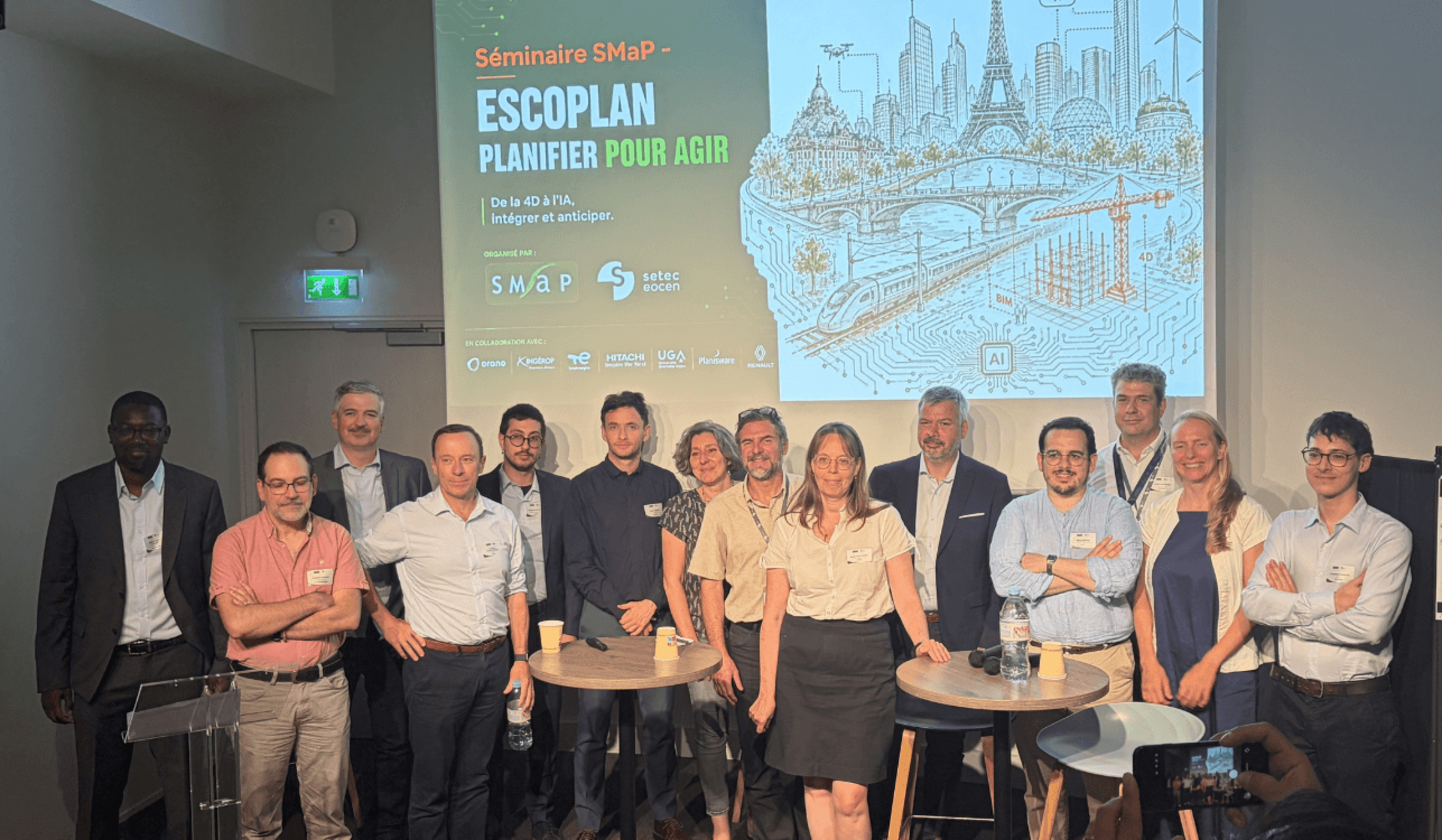
On 29 June, SMaP and setec eocen brought together more than a hundred project management professionals for the ‘Planning for Action’ seminar, held in a hybrid format at setec’s headquarters in Paris.
Throughout the afternoon, the event highlighted the growing interest amongst professionals in the ongoing transformations within the planning profession.
From model to construction site: 4D put to the test in the field
Feedback from Xavier SEGUIN and Bechara NOUJEIM (Ingerop) and Gérald NEYRET (Orano Projets) illustrated the real benefits of 4D planning, whilst highlighting the conditions for its success: common rules, upstream data structuring, and team alignment. Participants were also able to appreciate the spectacular progress made in recent years in the field of project visualisation and simulation.
Multi-disciplinary planning: synchronising life cycles
Olga ABRAMOVSKIKH (TotalEnergies) and Evelyne FURUI (Hitachi Rail) shared their vision of multi-disciplinary planning applied to hybrid projects combining physical infrastructure and digital systems. They highlighted the specific risks associated with the pre-commissioning phases and the need to better synchronise the different life cycles of components and systems.
AI and planning: a revolution to be built collectively
Following an introduction by Humbert FIORINO (Grenoble Alpes University) on automated planning and its practical applications, particularly for drone missions, the day concluded with a round-table discussion notable for the complementary nature of the participants’ backgrounds. A solutions provider – Laurent TRIOULEYRE (Planisware), a major manufacturer – Marie-Claire FEYEL (Renault), a consultancy firm – Antoine CHAUDAGNE (setec eocen) and an academic researcher (Humbert FIORINO). This diversity enabled the topic to be approached from perspectives rarely brought together in a single forum: what kind of artificial intelligence are we actually talking about? Who controls the data? Why does adoption remain difficult in practice, despite operational technologies being available? A common thread emerged: data structuring is the fundamental prerequisite, regardless of the technology under consideration. And the project manager’s responsibility – their judgement and control over the project – remains central.
The numerous messages received following the event, praising the quality of the presentations, the relevance of the topics and the impeccable organisation of the seminar, bear witness to the interest generated by this edition. A great collective success which confirms that planning remains, more than ever, an essential tool for navigating an increasingly complex world of projects.