

Continuation of the article “Passions and Papers“.
In this second part, we explore the contributions of project management to contract management and the multiple dimensions of the customer-supplier relationship.
Project management as Support!
1. Project planning
Planning is much more than a management tool: it is the beating heart of contractual coordination. Four levers deserve particular attention:
-
The project life cycle and its milestones: to structure key steps, synchronization points and clearance of reservations.
-
Impact analysis on Planning: to adapt the contractual schedule to incoming changes and support claims.
-
The measurement of physical progress: essential for updating the payment plan and invoicing.
-
The time-time curve (or 45° curve): powerful visual tool to detect deviations and quickly alert the project manager and management as soon as possible.
2 – Project reporting
4 boxes, updated schedule, risk status, financial monitoring, change tracking, etc. the progress report remains a classic but fundamental tool in the relationship between supplier and customer. It must be developed with rigor and consistency, because it constitutes both an information vector and a traceability tool.
In case of difficulty, a well-constructed report will allow you to explore the past and answer crucial questions:
-
Was this issue flagged? When?
-
What was the status of the project when this decision was made?
Reporting is not without challenges, however:
-
On large-scale or institutionally funded projects, it can span hundreds or even thousands of pages.
-
On complex projects, the client schedule is often a compilation of multiple source schedules, making its consolidation particularly delicate.
Beyond contractual obligation, reporting should be seen as a shared management tool — enabling reflection, anticipation of upcoming phases, detection of weak signals, and co-construction of solutions with the client.
3. Official communications
Contract management also relies on formal correspondence. In the UK, standardized civil engineering contracts like NEC (New Engineering Contracts) identify six major types of communication:
-
Alert letter: reporting a blockage (e.g.: waiting for the liberation of an area or provision of data).
-
Claim: request for compensation for an unforeseen event.
-
Communication: exchange of information without immediate contractual implications.
-
Instruction: client directive to maintain progress, which may result in compensation.
-
Technical request: request for clarification on a requirement or solution.
-
Reporting: notification of a quality deviation or delay, often accompanied by a request for price correction.
On major international projects, these exchanges can be voluminous —up to 100 letters per month, as was the case on a metro project in the Middle East. In this context, the presence of a dedicated contract manager, working closely with the PMO team, becomes an essential lever for maintaining a smooth contractual relationship.
Specialized tools such as CEMAR (Contract Event Management and Reporting) or AI-enhanced analysis solutions such as Lili.ai can automate the detection of sensitive events and efficiently compile supporting evidence in claim files.
The Pyramid of Collaboration
Borrowed from Vincent LENHARDT, a pioneer of coaching in Europe, this approach offers a three-layered reading of client-supplier collaboration:
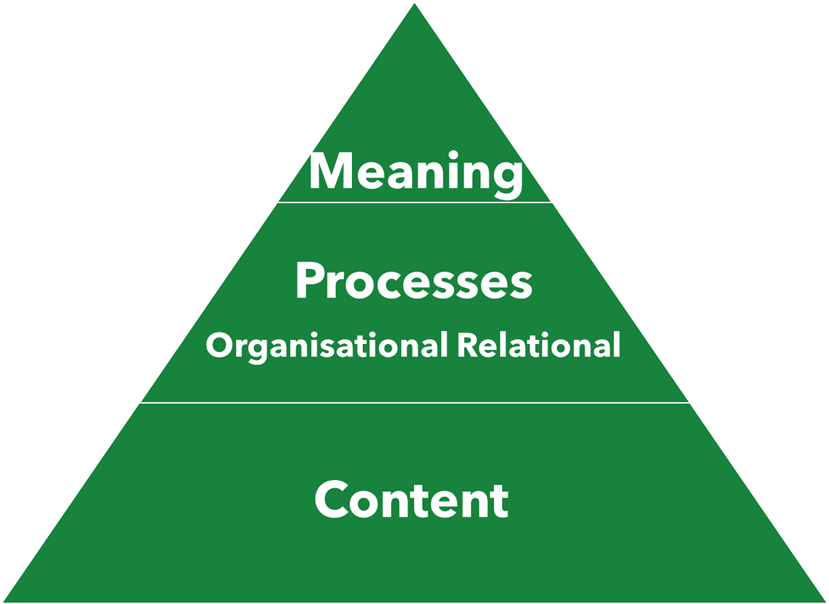
1. The Base: Content
These are deliverables, data, reports, minutes, etc. This level calls, among other things, for the establishment of collaborative, structured and carefully administered workspaces — a challenge that is often underestimated over time.
2. The Centre: Organisational and Relational Processes
This level encompasses shared organizational bodies and processes. Their relevance and effectiveness must be regularly evaluated.
Example: An aerospace tooling project reviewed technical progress and the instruction of changes during the same meeting. This setup proved destabilizing due to the tension between the desire for design convergence and the potential impact of certain modifications. After reflection, the project management decided to separate the meetings, which brought calm to the discussions.
This level also includes relational processes. The goal here is to maintain healthy working relationships, provide opportunities to express dissatisfaction, identify and manage tensions and conflicts, maintain the pleasure of working, and recognize contributions. Often implicit and sometimes overlooked, these processes are present in all working relationships. They are amplified for those involved in contract management, particularly during the negotiation and contingency-handling phases.
As one project director interviewed for this article noted, emotional maturity develops gradually. There’s no magic formula, but some qualities help: rigor and professionalism, trust, attentiveness to others to ease interactions, and composure and calm to manage tensions when they arise.
3. The peak: Meaning
Meaning, otherwise known as “why,” perfectly embodied by JF Kennedy in the Apollo program launch speech “We choose to go to the moon.” Pride in a significant achievement, pride in customer or user satisfaction, and finally pride in a successful collaboration, are all powerful and lasting motivators that must be activated.
Moving the relationship forward: thinking beyond the project
Are current negotiations over the latest developments dragging on and your relationship with your client or supplier is deteriorating? Look up: you’re probably in a long-term relationship.
In the automotive industry alone, for example, an equipment manufacturer can support a product for more than 20 years: pre-sales (1 year), development time (3 years), production (between 3 and 15 years), then after-sales service (10 years).
What can we say about energy systems (nuclear power plants) or weapons systems (aircraft carriers, submarines), where the lead times are even longer.
Beyond the deliverables, ask yourself the right questions:
-
What image are you leaving? That of a reliable, responsive, innovative partner?
-
How did you handle the challenges? What lessons did you learn from them?
-
Have you been able to build lasting relationships? Do you maintain your network?
-
How do you integrate your customer into your future developments? How do you showcase and promote your progress?
There is no single answer. But asking questions is already a step toward relational progress.
Thank you for your attention. See you in a future article.
Contributors to this article : Damien Sejourne, Head of the Project Department at Ascent Integration Europe, Francois Potterie, and Philippe BICHE, Projects Director at setec, Laurent PALETTA, Managing Director at setec IPMC – Project Management, Complex Solution development and transformation consulting , Franck Suchet, Sales Director at setec eocen, Antoine Chaudagne, Technical and Sales Director at setec eocen, and eocen experts: Sébastien CLEMENT, Baptiste Demeocq – PMP®, Arnaud DESTREEZ, PMP®, Abdelghafour Tarajja and Younes Essoudy Mourry.